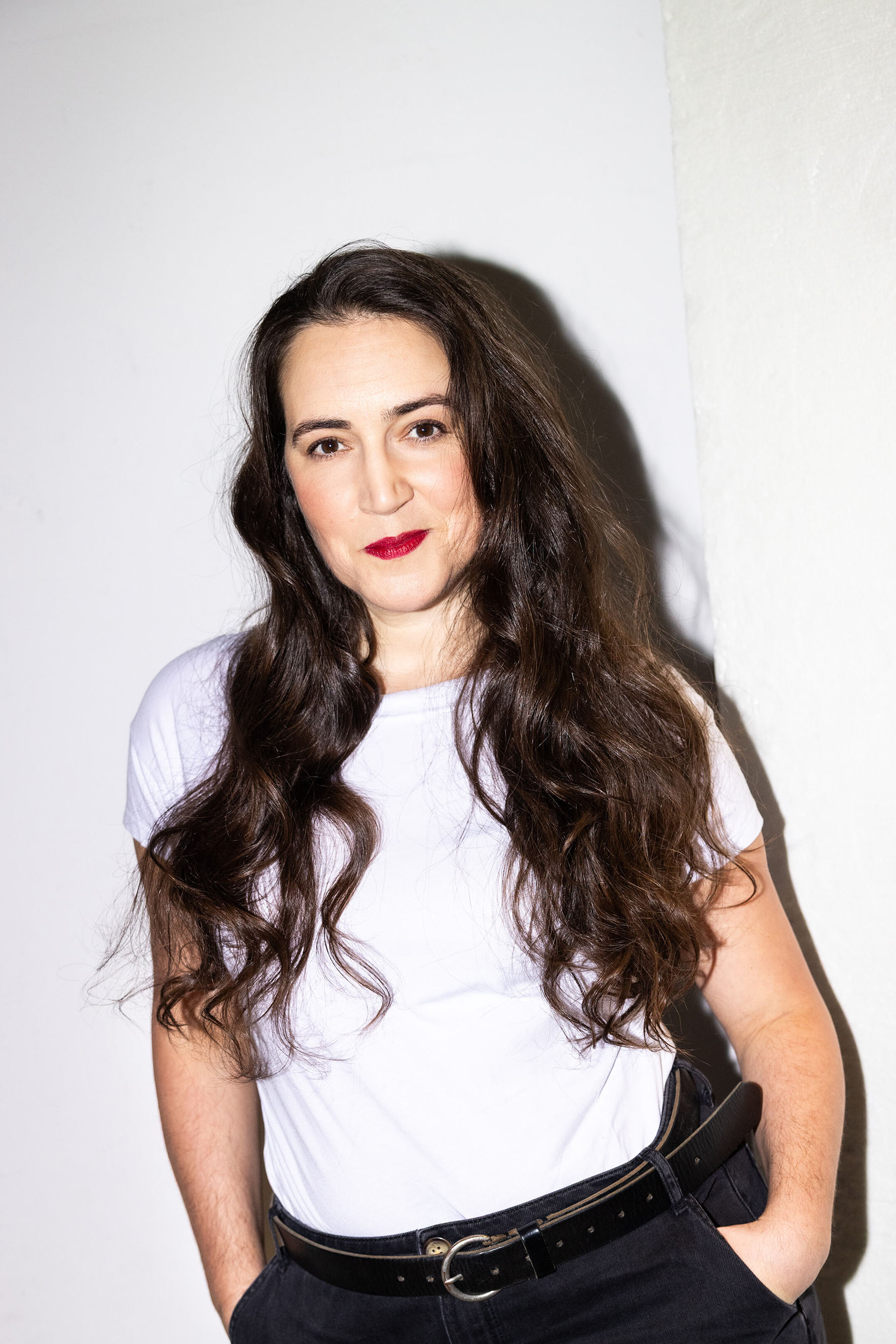
Maria Milisavljević is a playwright and one of the most prominent and influential voices in contemporary German theatre. She further works as a translator and holds a Ph.D. in British Cultural Studies. Maria’s works were produced by well-renowed theatres such as Deutsches Theater Berlin, Burgtheater Vienna, Thalia Theater Hamburg, Residenztheater Munich, Schauspielhaus Zürich as well as in New York, London, Toronto, and Mexico City.
Her main works are Brandung (Engl. Abyss, winner of the Kleistförderpreis and nominated for a Dora Mavor More Award in the Category "Outstanding New Play"), Beben (Engl. Noise, winner of the Else-Laske-Schüler-Play-Award, the Author’s Award at the Heidelberger Stückemarkt, nominted for the Mülheimer Dramatikpreis as well as Theatertreffen-Stückemarkt), and Staubfrau, which won the 2025 Mülheim Dramatikpreis as well as the Audience Award. In 2026, Maria received the Else-Lasker-Schüler-Drama-Award for her life’s work.
Maria grew up in a working class context in a small catholic village in the West of Germany. Her family has Serbian roots, with her grandfather arriving in Germany in 1941 as a German P.O.W.. Assimilation, integration and being an outsider in your own home country have been part of Maria’s experience from the start, and are part of her creative perspective until today. Her writing is highly political as well as deeply poetic. Her works deal with social injustices, power structures, gender-specific violence, and the force of solidarity and empathy.
Maria also works as a translator, translating plays by Anne Carson, Sam Max, and Gracie Gardner amongst others into German. She also teaches creative writing at the University of Applied Sciences in Vienna and Bard College Berlin, to name a few.
The jury of the 2026 Else-Lasker-Schüler-Drama-Award: "In her plays Maria Milisavljević disects the experiences of violence, oppression, and contempt, particularly from a female perspective, with the hightest poetic precision. Her texts combine poetic density with crystal-clear analyses of every day life. Milisavljević does not avoid reality, but deepens it, lays bare archaic patterns and draws counter images of empathy, solidarity and community. […] her works mirror her work experiences in London, Toronto, and Germany and combine these in a writing practice of extreme importance and precision."